
NEWS – ANNOUNCEMENTS


DIGITAL SCHOOL SERVICES IN A NUTSHELL

e-me DIGITAL EDUCATIONAL PLATFORM
e-me
[Greek & English, official edition]
European e-me for all
[multilingual, open edition]
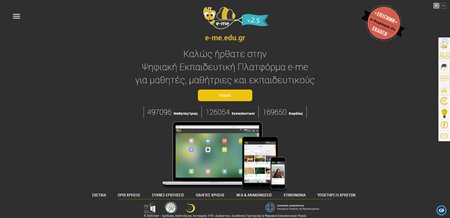
e-me (https://e-me.edu.gr) is a modern, collaborative, social, and extendable Digital Educational Platform for pupils and teachers. It was designed for the Greek Ministry of Education and Religious Affairs (MoE), as a national asynchronous learning platform for all Greek schools, teachers and pupils, providing a safe digital collaborative workspace to support formal, non-formal and informal learning experiences.
e-me is a Personal Learning Environment (PLE) which supports:
- creation of private and public collaboration spaces (hives) by teachers and pupils,
- communication and social networking among pupils and teachers,
- organization, storage and exchange of files on the cloud,
- easy creation of digital interactive learning resources,
- assigning and monitoring of tasks,
- creation of e-portfolio for keeping selected personal achievements,
- display of work and results to the outside world via collaborative and personal blogs,
- use of open educational resources (OERs) from Photodentro digital repositories,
while it further provides a suite of digital “tools” to support teaching and learning.
e-me is available in two editions/installations in Greece: (a) the official e-me (e-me.edu.gr | login with GSN account) and (b) the European e-me for all (e-me-4all.eu), which supports educational collaborations at European level.






e-me DIGITAL EDUCATIONAL PLATFORM
e-me
[Greek & English, official edition]
European e-me for all
[multilingual, open edition]
e-me (https://e-me.edu.gr) is a modern, collaborative, social, and extendable Digital Educational Platform for pupils and teachers. It was designed for the Greek Ministry of Education and Religious Affairs (MoE), as a national asynchronous learning platform for all Greek schools, teachers and pupils, providing a safe digital collaborative workspace to support formal, non-formal and informal learning experiences.
e-me is a Personal Learning Environment (PLE) which supports:
- creation of private and public collaboration spaces (hives) by teachers and pupils,
- communication and social networking among pupils and teachers,
- organization, storage and exchange of files on the cloud,
- easy creation of digital interactive learning resources,
- assigning and monitoring of tasks,
- creation of e-portfolio for keeping selected personal achievements,
- display of work and results to the outside world via collaborative and personal blogs,
- use of open educational resources (OERs) from Photodentro digital repositories,
while it further provides a suite of digital “tools” to support teaching and learning.
e-me is available in two editions/installations in Greece: (a) the official e-me (e-me.edu.gr | login with GSN account) and (b) the European e-me for all (e-me-4all.eu), which supports educational collaborations at European level.






DIGITAL LIBRARIES
The “Interactive Textbooks” Digital Library (ebooks.edu.gr) is the official digital repository of the Greek Ministry of Education & Religion Affairs (MoE) for hosting and openly sharing to pupils, teachers, and anyone interested, all official textbooks for primary and secondary education, for all subjects, and in multiple digital formats. A large number of textbooks have been enriched with online, click and play interactive Open Educational Resources.
It has been developed as a modern, online digital library, providing advanced search and navigation features for textbooks and courses, in a variety of ways.
In the “Interactive Textbooks” Digital Library you can find:
- 800 Textbooks for Primary School, High School, and Vocational Senior High School (EPA.L) in digital pdf format.
- 164 Textbooks in open, editable html format, which resembles their printed form.
- More than 160 Interactive Textbooks: textbooks in html or pdf format, enriched with digital interactive learning objects.
- Search within the pages of the interactive textbooks for active icons that lead and open directly relevant simulations, experiments, exercises, educational games, videos, maps, visualizations, etc. hosted in various “Photodentro” Repositories.
- 120 textbooks with 18 to 38 point fonts for amblyopic students.
- 41 Student’s Textbooks in iBook format.
You can also find a list of all courses for Primary, Junior High School, General High School and EPA.L., with a full description page for each one and direct access to all associated Textbooks of the course, in all available digital formats, as well as to all relevant course Curriculum program (D.E.P.P.S. or A.P.S.).
You can also use the multiple filters of the Interactive Textbooks Digital Library to easily search and find Textbooks according to their educational level, grade, textbook type, category, or subject matter etc. You can even search by keywords within Textbooks body!
The “Melispi” Digital Library of Greek School Textbooks (ebooksdl.cti.gr) is a modern, nationwide digital platform that serves as a cornerstone of the Multiple Textbook Initiative of the Ministry of Education, Religious Affairs and Sports (MoE) of Greece.
The platform provides open access to all newly approved textbook packages for Primary and Secondary Education. Each package comprises the textbooks for a specific subject and the associated Digital Learning Objects that support and enrich the learning experience.
More specifically, each Textbook Package corresponds to a specific school subject and includes:
- Subject textbooks in three digital formats:
- PDF: A fixed-layout format for reading and printing that preserves the appearance and formatting of the printed textbook, with Digital Learning Objects linked via QR codes.
- iPDF (Interactive PDF): An interactive format in which the accompanying Digital Learning Objects are connected through active icons / hyperlinks.
- EPUB: A flexible and responsive format optimized for a wide range of devices, including tablets, smartphones, and e-readers. In this format, Digital Learning Objects are also integrated through active icons / hyperlinks.
- Digital Learning Objects (DLOs) that are linked to and accompany the textbooks, such as simulations, interactive exercises, educational games, videos, maps, and other learning resources.
“Photodentro”
OPEN EDUCATIONAL RESOURCE (OER) REPOSITORIES
Photodentro is the name of the Greek digital repository infrastructure for hosting, organizing, and providing open access to OERs for primary and secondary education.
The Photodentro ecosystem consists of five (5) OER Repositories, each one serving a different purpose.
CURATED CONTENT
LEARNING OBJECTS – EDUCATIONAL VIDEOS – EDUCATIONAL SOFTWARE
Photodentro LOR+ is the Greek National Repository of Digital Learning Objects for Primary and Secondary Education. It constitutes a core digital repository service of the Ministry of Education, Religious Affairs and Sports (MoE), supporting the hosting, organization, documentation, and dissemination of Open Educational Resources (OERs) for school and pre-school education.
Photodentro LOR+ provides open access to:
a) Learning Objects, i.e. self-contained, reusable units of digital educational content that support teaching and learning, such as simulations, visualizations, virtual experiments, inquiry-based activities, images, educational games, 3D maps, exercises, and more.
The repository includes over 7,500 learning objects developed within the framework of the Digital School initiative, accompanying enriched digital textbooks. These resources span a wide range of subject areas, from kindergarten to Grade 11, and are continuously maintained, updated,
and enhanced to ensure full compatibility with modern web browsers.
b) Short educational videos, designed for integration into learning activities to support key curriculum concepts (curriculum-related core concept clips).
The collection includes content from Educational Television, videos produced in the Digital School initiative, European co-produced documentaries, and other curated material.
c) Educational software available for download, including multimedia applications, packages with educational scenarios, authoring tools, and open learning environments.
These applications have been developed or localized within projects of the Ministry and its affiliated bodies, or selected from high-quality open-source solutions.
Photodentro LOR+ implements the national strategy for digital educational content and promotes the systematic use of Open Educational Resources (OER) in education.
All learning objects in Photodentro LOR+ are openly available under the Creative Commons Attribution–NonCommercial–ShareAlike (CC BY-NC-SA) license.
EDUCATIONAL COMMUNITY CONTENT
Photodentro Repositories for User-Generated content
Four (4) Photodentro repositories where teachers, students or academics can upload and share their own learning resources.
Photodentro UGC
(User Generated Content)
Photodentro UGC is the Greek National Repository of User Generated Content for primary and secondary education. It offers teachers a digital space to upload and share their own Open Educational Resources (OERs), while encouraging them to use, adapt and reuse, comment or rate resources by others, contributing thus to the development of the Greek professional social network of teachers for resource-based learning.
Here you can find ~2.500 OERs developed and shared by teachers, students or academics, including interactive exercises, educational scenarios, educational games, presentations, simulations, lesson plans, educational videos, etc.
Photodentro LS (Learning Scenarios) Repository & Learning Scenario Designer
Photodentro LS is the Greek National Repository of structured Learning Scenarios with didactive activities for primary and secondary education. It provides the Photodentro LS Designer tool for teachers and researchers, to design, author, host, publish and share Learning Scenarios with didactive activities, using online Templates for learning scenarios and following specific pedagogical guidelines and suggestions, as well as to search, adapt and reuse learning scenarios shared by others. It also supports the development of customizable LS Templates (Photodentro LS Template Designer).
In Photodentro LS repository you can find ~160 open Learning Scenarios created by teachers, as well as a Generic and 12 specialized Templates for Learning Scenarios, along with pedagogical guidelines and suggestions defined by scientific and pedagogical experts.
Photodentro OEP
(Open Educational Practices)
Photodentro OEP is the Greek National Repository of Open Educational Practices for primary and secondary education. It aims at encouraging and motivating teachers to develop and share Open Educational Practices (OEPs), i.e. reusable teaching techniques that draw upon Open Educational Resources (OERs), have been implemented in a real educational setting, and are openly shared along with the related experiences and reflections.
Here you can find 197 Open Educational Practices recommended by teachers. All OEPs are freely available to everyone and are provided under Creative Commons BY-NC-SA license.
Photodentro I-CREATE
Photodentro i-create is the Greek National Repository of student creations, operated by the Greek Educational TV (EduTV) to support creativity, exchange and production of ideas and promote school communities’ projects. It hosts videos, blogs, posters, and other audiovisual creations, developed by students and submitted through EduTV video contests or awareness-raising campaigns.
Here you can find ~1.900 student creations organized into collections.
PHOTODENTRO Greek National Aggregator of Educational Content
PHOTODENTRO is the Greek National Aggregator of Open Educational Resources (OERs) for Primary and Secondary Education. It’s the Greek national service for harvesting and accumulating educational metadata from various repositories and collections (museums, libraries, audiovisual archives, etc.), thus serving as the central access point to Greek open learning resources for schools.
In PHOTODENTRO portal, at photodentro.edu.gr, you can search in a unified way and find Greek OERs for K-12 education, hosted either in “Photodentro” Repositories of the Ministry of Education, or in other, “external” repositories or educational portals. In other words, PHOTODENTRO provides a central “catalogue” of the Ministry of Education’s digital educational material for school education. It currently provides access to ~18.000 OERs, from 19 repositories and 23 content providers.
PHOTODENTRO promotes the use of OERs for schools. All digital resources available through PHOTODENTRO is freely available under Creative Commons CC BY-NC-SA or similar open licenses.
Thematic Aggregator Of Cultural Educational Resources

Photodentro Cultural
Photodentro Cultural is a thematic aggregator of Greek cultural educational resources targeting Primary and Secondary education. It provides unified access to thousands of selected digital resources of cultural collections, from various content providers including “Europeana” (europeana.eu), hosted in digital repositories of museums, libraries, or other institutions.
All digital resources of Photodentro Cultural have been enriched with descriptions, pedagogical metadata, and classifications for their educational use, to facilitate their constructive use in the educational process.
“Greek National Aggregation Service of Digital Educational Content for Primary and Secondary Education”
“Photodentro Aggregation Service” is the Greek National Aggregation Service of Digital Educational Content for Primary and Secondary Education”. It is a modern service for harvesting, semantically integrating, and enriching the metadata of Open Educational Resources, accumulated from various digital repositories or collections and by various content providers, and further distributing these resources via the PHOTODENTRO central portal of OERs for Greek K-12 education (photodentro.edu.gr).
PHOTODENTRO microsites
PHOTODENTRO microsites are autonomous and thematically focused websites, aiming at providing various target audiences with easy access to relevant PHOTODENTRO’s Open Educational Resources (OERs).
A PHOTODENTRO microsite provides a “view” of a subset of PHOTODENTRO Aggregator’s resources relevant to its target audience. It has an easy-to-use, customized for its target audience GUI, offering ready-made queries to PHOTODENTRO portal, with predefined combinations of filters.
Two microsites are available:

MICROSITE “Photodentro PRIMARY”
A PHOTODENTRO microsite for Primary school pupils and teachers.
It provides easy access to PHOTODENTRO Open Educational Resources targeting primary school pupils (aged 6-12).

MICROSITE “Photodentro ENGLISH”
A PHOTODENTRO microsite for English language teachers, school counselors, and all those involved in the English language teaching. It provides easy access to PHOTODENTRO Open Educational Resources for English language teaching.
PHOTODENTRO Greek National Aggregator of Educational Content
PHOTODENTRO is the Greek National Aggregator of Open Educational Resources (OERs) for Primary and Secondary Education. It’s the Greek national service for harvesting and accumulating educational metadata from various repositories and collections (museums, libraries, audiovisual archives, etc.), thus serving as the central access point to Greek open learning resources for schools.
In PHOTODENTRO portal, at photodentro.edu.gr, you can search in a unified way and find Greek OERs for K-12 education, hosted either in “Photodentro” Repositories of the Ministry of Education, or in other, “external” repositories or educational portals. In other words, PHOTODENTRO provides a central “catalogue” of the Ministry of Education’s digital educational material for school education. It currently provides access to ~18.000 OERs, from 19 repositories and 23 content providers.
PHOTODENTRO promotes the use of OERs for schools. All digital resources available through PHOTODENTRO is freely available under Creative Commons CC BY-NC-SA or similar open licenses.
Thematic Aggregator Of Cultural Educational Resources
Photodentro Cultural
Photodentro Cultural is a thematic aggregator of Greek cultural educational resources targeting Primary and Secondary education. It provides unified access to thousands of selected digital resources of cultural collections, from various content providers including “Europeana” (europeana.eu), hosted in digital repositories of museums, libraries, or other institutions.
All digital resources of Photodentro Cultural have been enriched with descriptions, pedagogical metadata, and classifications for their educational use, to facilitate their constructive use in the educational process.
“Greek National Aggregation Service of Digital Educational Content
for Primary and Secondary Education”
“Photodentro Aggregation Service” is the Greek National Aggregation Service of Digital Educational Content for Primary and Secondary Education”. It is a modern service for harvesting, semantically integrating, and enriching the metadata of Open Educational Resources, accumulated from various digital repositories or collections and by various content providers, and further distributing these resources via the PHOTODENTRO central portal of OERs for Greek K-12 education (photodentro.edu.gr).
PHOTODENTRO microsites
PHOTODENTRO microsites are autonomous and thematically focused websites, aiming at providing various target audiences with easy access to relevant PHOTODENTRO’s Open Educational Resources (OERs).
A PHOTODENTRO microsite provides a “view” of a subset of PHOTODENTRO Aggregator’s resources relevant to its target audience. It has an easy-to-use, customized for its target audience GUI, offering ready-made queries to PHOTODENTRO portal, with predefined combinations of filters.
Two microsites are available:
MICROSITE “Photodentro PRIMARY”
A PHOTODENTRO microsite for Primary school pupils and teachers.
It provides easy access to PHOTODENTRO Open Educational Resources targeting primary school pupils (aged 6-12).
MICROSITE “Photodentro ENGLISH”
A PHOTODENTRO microsite for English language teachers, school counselors, and all those involved in the English language teaching.
It provides easy access to PHOTODENTRO Open Educational Resources for English language teaching.
OTHER DIGITAL REPOSITORIES
of the “Photodentro” family
Photodentro PAFSE:
European Digital Repository for STEM OERs
Photodentro PAFSE is a European Digital Repository of Open Educational Resources for STEM education (Science, Technology, Engineering, and Mathematics), with a strong focus on public health literacy.
It was developed under the European project PAFSE (Partnerships for Science Education) to host, organize, systematically classify, document, and share Learning Resources and Educational Scenarios developed within the project, all of which are freely available.
IFIGENEIA:
Digital Library for B-Level ICT Teacher Training Scenarios
“Ifigeneia” is a Digital Library of Educational Scenarios developed for the B-Level ICT teacher training Programme, designed to support the training process and the wider community of educators involved in it.
It is intended for teachers who are currently enrolled in or have previously completed training programmes on the pedagogical use of digital technologies (ICT Levels B, B1, and B2), for certified ICT Level B trainers, and for members of the programme’s academic and support teams. It provides an environment where users can design, upload, and share educational scenarios that integrate digital technologies and showcase effective classroom practices.
The “Ifigeneia” Digital Library is based on the “Photodentro Educational Scenarios” repository and the “Photodentro Learning Scenario Designer” authoring and management platform.

Photodentro Cyprus
Photodentro Cyprus is the Repository of User Generated Content for Primary and Secondary Education in Cyprus.
It hosts open educational resources developed, uploaded, and shared by teachers or members of the broader educational community of Cyprus.
Here you can find ~1,850 learning objects, such as educational scenarios, videos, exercises, educational games, etc.
Photodentro Cyprus is based on the Greek “Photodentro UGC” User Generated Content repository, as an adapted version for Cyprus, while operating with independent content.
icRepo:
Digital Repository of Innovation Centres
The icRepo Digital Repository was developed to host, organize, and share the digital material of the Innovation Centers, specifically the digital learning resources created by scientific teams, as well as material generated from various implementation and operational activities of the Innovation Centres.
Through icRepo, users can discover and interact with innovative digital resources, such as Virtual Reality (VR) and Augmented Reality (AR) applications, 3D models, and explore pioneering educational activities.
STATISTICS &
QUALITY ASSURANCE

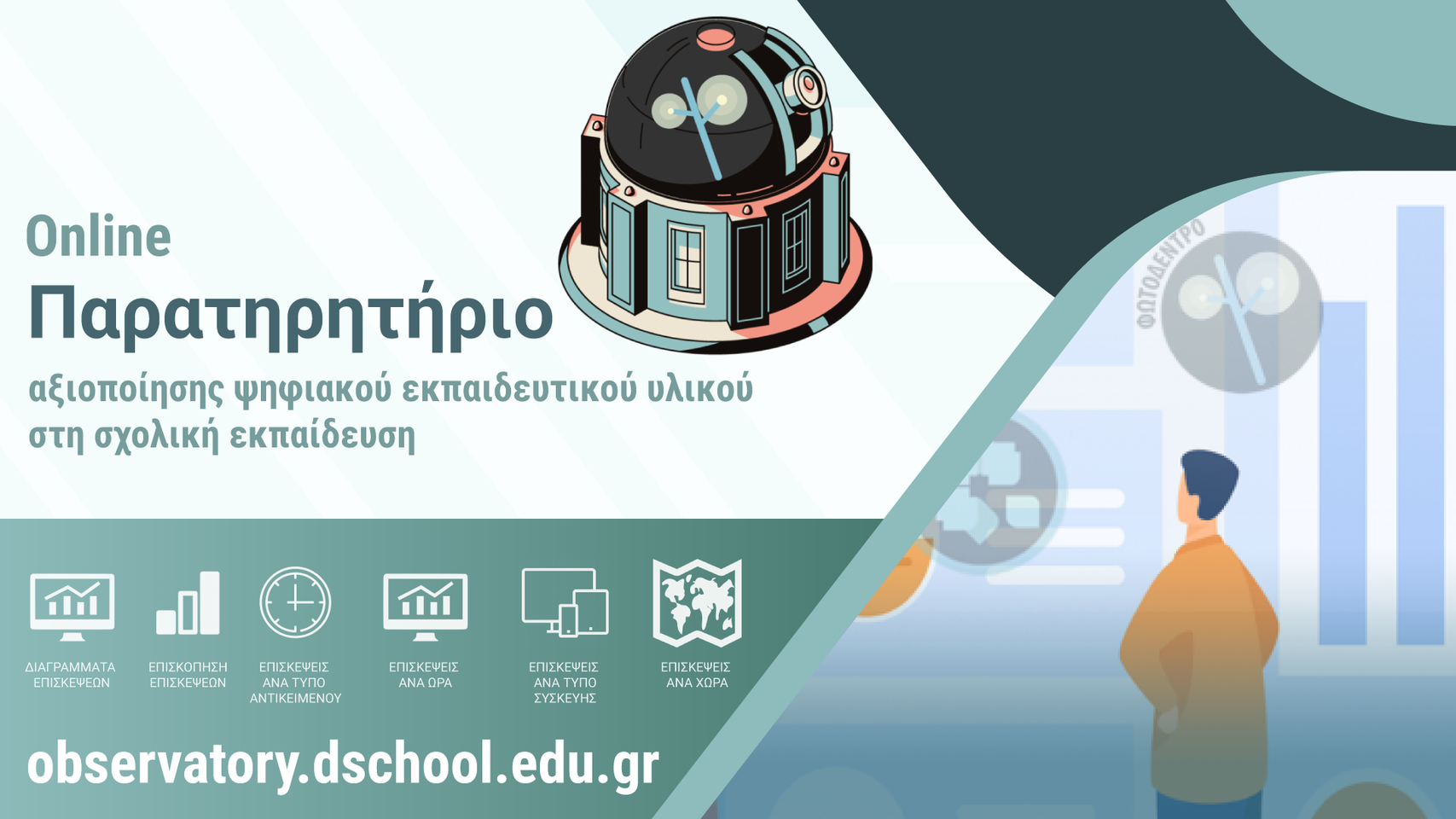
Digital Educational Services OBSERVATORY
Greek online Observatory on the utilization of K-12 digital educational content and e-services
The “Digital Educational Services OBSERVATORY” is the first Greek public, open and online Observatory for the utilization of digital educational resources in Greek Primary and Secondary education.
Following the “OBSERVING – MEASURING – IMPROVING” approach, the OBSERVATORY aims at promoting the wider utilization of the available digital educational content for school and preschool education. The OBSERVATORY is an important tool of the Greek Ministry of Education for the scientific monitoring of information regarding the utilization of digital educational content and relevant online services by the educational and the academic community, as well as the general public.
In the OBSERVATORY you can find statistics on the use of Open Educational Resources (OERs) hosted on Photodentro Digital Repositories, of digital textbooks hosted on the ebooks digital library, of digital OER collections accumulated on the PHOTODENTRO Greek National Aggregator, as well as on the utilization of the e-me Digital Educational Platform for pupils and teachers.

Photodentro Quality Seals
“Photodentro Quality Seals” supports and facilitates the Quality Assurance process of Open Educational Resources for Primary and Secondary Education. It hosts: (a) “Quality Seals” of Open Educational Resources, (b) “Quality Seal holders (Certifiers)” who own and award the Quality Seals, and (c) “Sealing (stamping)” of Open Educational Resources awarded with these quality seals.
SERVICES FOR
ORGANIZATIONS (B2B)
Textbook Submission System (SYDV)
The Textbook Submission System is intended for authors who have been approved to write school textbooks within the framework of the Multi-Textbook initiative. It provides a digital environment for uploading, metadata-based documentation, and submission for evaluation of Digital Textbooks and their accompanying Digital Learning Objects (DLOs). It interoperates with and supports the Digital Textbook Library “Melispi”.
The Evaluation Subsystem of SYDV supports the evaluation process of textbooks and their accompanying DLOs, with the aim of their inclusion in the Textbook Registry and the Digital Textbook Library “Melispi”. It is intended for scientific committees and evaluators appointed by the Institute of Educational Policy.
Photodentro SaaS
The Photodentro SaaS service is based on the Software as a Service (SaaS) model and provides modern digital educational repositories and repository-related services. It enables interested parties to acquire their own Photodentro-like digital repository of educational resources, tailored to their own needs, or to create and host their own digital collections on an existing “Photodentro” repository, thus providing a web-based service for organizing, documenting and distributing their content.
OTHER EDUCATIONAL
PLATFORMS

mooc.edu.gr platform for MOOCs
The mooc.edu.gr platform is the official online platform available by the Ministry of Education and Religious Affairs (MoE) for hosting and making available Massive Online Open Courses (MOOCs) to teachers of Primary and Secondary Education, as well as to anyone interested.
iCollab:
iCollab is a modern Collaboration and Learning Platform, designed to support the operation and educational mission of the Innovation Centres.
It provides a flexible and interactive environment that brings together Centre staff, teachers, and students, fostering networking, learning, and creativity.
iCollab enables teachers, students, and Innovation Centre staff members to communicate, collaborate, and organize joint activities around the Innovation Centres.
With a rich set of tools and applications, users can plan visits, develop collaborative activities before, during, and after the visit, share ideas and educational resources, and co-create content.